
The Culture Vulture of Black Broadway: How Busboys and Poets Was Built on Black Ground
Listen to this article
Press play and take the patrol report with you.
Or listen in another language / choose a voice
Getting your device voices ready…
A reel landed on this desk the way tips land here: a man with a binder, standing in front of a camera, walking his viewers through printouts, laying out the charge page by page — one of the best-known restaurant chains in the Washington area trades on being Black-owned, and its owner is not Black.
The Patrol checked the paperwork: the directories, the platforms, the petition, the court filing, and twenty years of the owner describing himself and his plan in his own words. The paperwork is in. And this time the Patrol is not writing it down the middle, because the record does not sit in the middle. The record convicts.
The verdict: Andy Shallal is a culture vulture. He built an eight-location empire on Black ground — Black Broadway — under a Black poet's name, launched with a Black bank's money, fed for years by a Black-owned label he disowns in interviews — and the ownership, the equity and the empire are his alone. The men in that video have it right. So does the man who took him to court. Here is the file.
Built on Black ground
Start with the ground itself, because he chose it deliberately. The flagship of Busboys and Poets opened on September 7, 2005, at 14th and V Streets NW — the heart of the U Street corridor, Black Broadway, the strip Black Washington built when the rest of the city was closed to it. The name honors Langston Hughes, the Black poet who worked as a busboy at the Wardman Park Hotel in the 1930s. The walls carry a civil-rights mural the owner painted himself. The programming — the poetry, the politics, the Black authors on the stage and the Black books on the shelves — is the brand. The chain describes itself as "a place where art, culture and politics intentionally collide," "a community where racial and cultural connections are consciously uplifted."
None of that is an accident, and none of it is decoration. It is the product. Black culture is not the wallpaper at Busboys and Poets. Black culture is the business model — the draw that filled the room on opening night and has kept eight rooms filled for twenty years, from the flagship to Anacostia, from Brookland to Columbia, Maryland, where the chain opened its largest location in 2021.
A man is entitled to open a restaurant anywhere. What he is not entitled to is the harvest without the roots. And the roots go deeper than the décor — all the way down to the money.
The Black bank that underwrote it
Here is the fact that belongs at the center of this file, and it is not in dispute: the founding of Busboys and Poets was financed in part by a loan from Industrial Bank — the Black-owned bank at 11th and U.
Understand what Industrial Bank is. It stands at 11th and U Streets, in the heart of Black Broadway, because Black Washington needed a bank of its own and the white banks would not serve it. Jesse Mitchell, a Howard-educated attorney, reopened it in 1934, in the middle of the Great Depression, after its predecessor failed — because there was no other Black-owned bank in the city. By 1947 it was the largest Black-owned bank in the United States. It remains, today, the oldest and largest Black-owned bank in the Washington area — and one of a vanishing few anywhere. On FDIC figures, roughly twenty Black-owned banks remain in the entire United States: fewer than one in a hundred of the nation's insured banks.
That scarcity is the point. Black banking capital is some of the scarcest capital in America — a small, hard-kept pool, built deposit by deposit out of a community the banking system locked out for a century. Black entrepreneurs know what that scarcity means at the counter: the loan that doesn't come, the business that never opens, the second location that never happens, because the capital was never there for them. That is the everyday reality for the very people Busboys and Poets was built to attract.
And some of that scarce Black capital — lent by a Black institution, out of Black Broadway itself — underwrote Andy Shallal's launch. A non-Black owner got his start, on Black Broadway, with a Black bank's money, and turned it into an eight-location empire that he owns outright. The community's bank helped capitalize the business. The community got a venue. He got the equity. That is not partnership. That is extraction — the culture vulture's whole method, executed at the level of the loan itself.
In his own words
The defense in a case like this usually writes itself: he never claimed to be Black. True — and the Patrol will print it, because it is the most damning part of the file. He never had to claim it. The market claimed it for him, and he cashed the checks. Listen to the man, across twenty years:
Weeks after the flagship opened, in December 2005, Washingtonian recorded how he talked about his new Black Washington audience: "I am going to pander to the black community at some level. I want to win them over." Not serve. Not join. Pander — his word — and win them over, the way you win over a market.
In 2014, remembering the school race form he faced as a new immigrant kid in 1966: "We'd leave it blank, because, you know, I didn't think I was white and I didn't think I was black, and no kid wants to be the 'other'."
In 2017, on The Splendid Table: "I come from Iraq. I'm a brown person; I don't identify as black or white. For me, it was always this sort of strange puzzle that America is unable to come to grips with."
And in 2022, the Baltimore Sun reported that he had "always identified much more with Black culture" — in the same coverage where he was explicit that he does not identify as Black.
Lay the four statements side by side and the pattern reads itself. He will take the culture — he says so. He will take the community — as a market to be pandered to and won. He will not take the identity, because the identity is the one part that costs something. No statement exists, in any source, of the man claiming to be Black. He didn't need the claim. He needed the label — and the label was supplied.
The label that paid
For years, Busboys and Poets stood on lists of Black-owned businesses, and every year it stood there, the label did its quiet work: the searches it won, the roundups it appeared in, the customers who chose it believing their money was going to a Black-owned house.
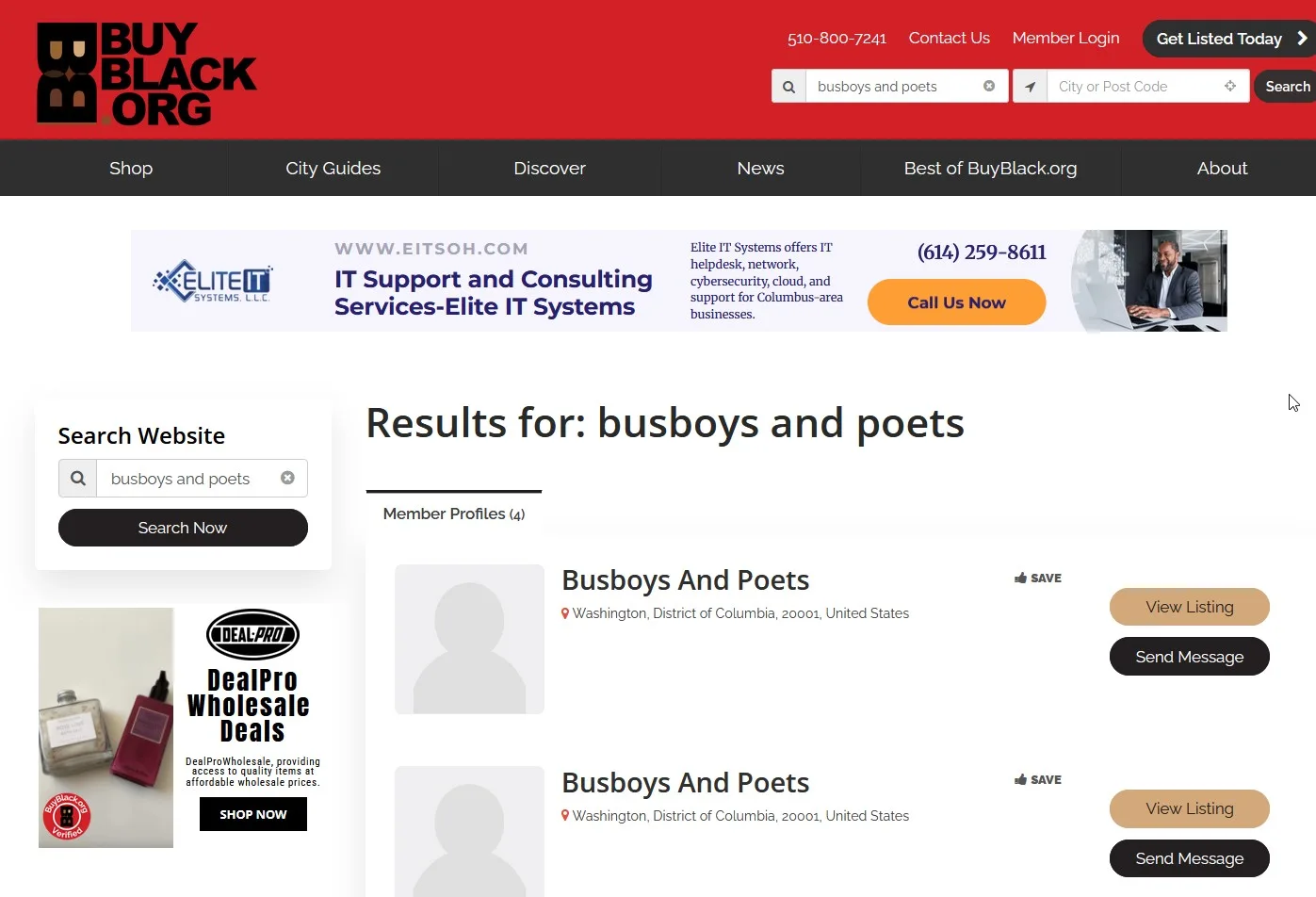
It stood in a listing on BuyBlack.org, a national directory of Black-owned businesses — until Black people organized to throw it out. A Change.org petition, "Demand Busboys and Poets stop identifying as black owned," went up September 3, 2025; the Baltimore Sun counted more than 1,170 verified signatures. Only then — after the petition, after the signatures, after the noise — did the listing come down, in late November 2025. The petitioner uploaded a screenshot of the listing that had stood there, so the removal would not erase the evidence. To this day, nobody at the company has said who created that listing, and nobody has apologized for it.
It stood in listicles and roundups — a Yahoo Finance list of Black-owned businesses, a Travel Noir roundup of Black-owned bookstores, a 2021 Associated Press story grouping the chain with Black-owned bookstores — and in the mouths of its own customers, repeating the label to this day: "It's a Black owned business that promotes books and creative arts," as one review puts it. In 2020, the year searches for Black-owned businesses surged, Postmates carried the chain in its "Black-owned" categories; Postmates says the company was not consulted. Noted, and printed. But notice: the benefit arrived anyway, unconsulted or not, and there is no record of the company refusing it. The same year, the chain's Anacostia location took a seat on the roster of DMV Black Restaurant Week — carried openly, the organizers say, as "the only allied partner on the list," on a roster where, as DCist noted at the time, it was the only restaurant east of the river. Even the ally seat was a seat a Black-owned restaurant did not get.
And then there is the tell — the exhibit that gives the whole game away. EatOkra is a discovery platform built specifically for Black-owned restaurants. As of today, November 1, 2026, Busboys and Poets has a live listing on it: the flagship, carrying the business's own marketing copy and links. The BuyBlack listing came down within weeks once a petition made it cost something. The EatOkra listing costs nothing to leave standing — so it stands. A business that wanted off Black-owned lists knows exactly how to get off them; it proved that in November 2025. What remains up, a year later, is what it is content to keep. Whoever typed the tags at the start, the label's benefit has flowed one direction for twenty years, and the flow has never once been turned off by the man it enriches.
The one platform that checked
Accuracy is this Patrol's whole authority, so the Yelp record goes in straight. The reel's sharpest exhibit was a Yelp search for "Black Owned Restaurants" in Columbia showing Busboys and Poets at number four, and Yelp's own documentation showing the "Black-owned" attribute is an opt-in a business adds to its own page. Yelp's answer, on the record, to the Baltimore Sun: no Busboys and Poets location has "currently or historically have indicated the Black-owned attribute on [Yelp]." The Patrol's own check, November 1, 2026, backs the platform up: Busboys does not appear in Columbia's current top ten for that search, and its claimed Columbia page lists some thirty attributes — "Black-owned" is not among them. A search ranking is not an opt-in; Yelp's results also rise out of review text, including reviews calling the place Black-owned.
But read that denial for what it actually proves. On the one platform where the business's own page can be audited line by line, the tag was never claimed — the owner is too careful for that. The label lived everywhere nobody audited: the directories, the roundups, the delivery categories, the word of mouth. Plausible deniability, maintained for twenty years, while the benefit compounded. That is not innocence. That is technique.
The lawsuit, and where the Patrol stands
Jordan Randall is the man with the binder, and he is not a bystander: he is a plaintiff, and his history with this chain belongs in the open. In November 2022 he signed an event consignment contract to promote and sell his novel Pinkface at the Columbia location. In November 2023 the chain cancelled. The paper trail, as the Baltimore Sun reported it from the complaint and the emails: the chain told him in writing the reversal was because "it is a book written about a marginalized experience that the author does not identify with," and called the book a mockery of real trans experiences. Randall, a Black cisgender man, says the cancellation followed the company receiving his headshot — that when they saw the Black author, the event died. Shallal's answer is on the record: the book is "disparaging to trans people"; "We had several people in our team who are trans. They looked at it; they said they don't like the book. It's not a thing we would support or want to have"; and on Randall's account, "Apparently [Randall] thinks the reason why we didn't do [it] is because he's Black, which makes no sense at all."
In August 2025, Randall filed suit in Howard County Circuit Court seeking $7.5 million — discrimination, breach of contract, defamation, and, among the counts, that the chain falsely advertised itself as a Black-owned business. In the lawsuit, that claim is an allegation. Ownership denies it. No court has ruled on it, and this Patrol does not print allegations as verdicts.
Here is the Patrol's verdict anyway — on the evidence, not the docket. The listings stood for years and one stands today. The owner's own words — pander, win them over, take the culture, decline the identity — are on the record in his own voice. The launch was underwritten by a Black bank on Black Broadway and the empire stayed in one man's hands. On that record, the Patrol finds Randall's charge credible, and the Patrol stands with the man who filed it.
The eight locations
For the record, the empire as it stands — addresses and phone numbers from the company's own contact page, checked November 1, 2026:
- 14th & V (flagship) — 2021 14th St NW, Washington, DC 20009 · 202-387-7638
- Columbia — 6251 Mango Tree Rd, Columbia, MD 21044 · 410-312-1272
- 450 K — 450 K St NW, Washington, DC 20001 · 202-789-2227
- Anacostia — 2004 Martin Luther King Jr Ave SE, Washington, DC 20020 · 202-889-1374
- Brookland — 625 Monroe St NE, Washington, DC 20017 · 202-636-7230
- Hyattsville — 5331 Baltimore Ave, Hyattsville, MD 20781 · 301-779-2787
- Shirlington — 4251 Campbell Ave, Arlington, VA 22206 · 703-379-9757
- Takoma — 235 Carroll St NW, Washington, DC 20012 · 202-726-0856
Eight locations. One owner. Zero of them Black-owned.
The verdict
A culture vulture is not a man who enjoys another people's culture. It is a man who builds on it — the name, the street, the bank, the audience, the label — and keeps every bit of the ownership for himself. By that measure the file on Busboys and Poets is not close. The name is Langston Hughes. The ground is Black Broadway. The seed money ran through a Black bank built so Black Washington could capitalize its own. The audience was courted in the owner's own word — pandered to. The label was worn for years and is worn on EatOkra still. And the man at the center of it tells interviewers, on the record, that he does not identify as Black.
Black-owned lists, directories and restaurant weeks exist to move visibility and money toward Black American businesses — toward the lineage those collections were built to find, the same lineage this Patrol exists to stand watch over (see who Foundational Black Americans are). Every slot this chain holds in them is a slot stolen from that work. The correction is not complicated: get off the lists — all of them, EatOkra included — and stop banking a label the owner disowns in his own interviews.
The Patrol prints answers where they exist, the same policy that put a wanted tether's own words on the record in the last case filed here. Busboys and Poets has denied false advertising in court and declined comment to other outlets since; its answer is invited the same way — on the record, publicly, through the Patrol's reporting channel at /report-a-tether.
Until then, the file reads as it reads. The culture was taken. The capital was Black. The equity is his. Culture vulture — case made.
Patrolling the online borders, one tether at a time.
Sources and further reading (checked 1 November 2026): Baltimore Sun — Busboys & Poets faces racial discrimination suit after canceling event (29 November 2025; Yelp statement, the cancellation paper trail, Shallal's response) · Daily Caller — Exclusive: Woke DC Coffee Chain Sued After Dropping Author Over Transgender Book (20 May 2026) · Change.org — Demand Busboys and Poets stop identifying as black owned (petition, 3 September 2025; BuyBlack.org removal update and listing screenshot, 27 November 2025) · EatOkra — Busboys and Poets listing (live, checked 1 November 2026) · DCist — DMV Black Restaurant Week east of the river (13 November 2020) · The Splendid Table — Andy Shallal on creating an inclusive dining experience (7 July 2017) · Reality Asserts Itself — Being the "Other" in America: Andy Shallal (25 March 2014) · Washingtonian — Todd Kliman, "Rainbow Room: The Busboys and Poets Controversy" (1 December 2005) · Wikipedia — Busboys and Poets · Wikipedia — Andy Shallal · Wikipedia — Industrial Bank (Washington, D.C.) · MBN Media — Less than 1% of all FDIC-insured banks are Black-owned, according to the FDIC (FDIC figures: roughly twenty Black-owned banks remain) · Gizmodo — Turns Out Pretty Much Anyone Can Claim to Be a Black-Owned Business on Uber Eats (11 December 2020) · Busboys and Poets — official contact page (locations and phone numbers) · Yelp — "Black Owned Restaurants," Columbia, MD, and the Busboys and Poets Columbia business page (checked 1 November 2026: no Black-owned attribute) · BuyBlack.org — site search for Busboys and Poets (checked 1 November 2026: no listing)
Tags: Busboys and Poets Black-owned · Andy Shallal · Busboys and Poets lawsuit · is Busboys and Poets Black owned