
How to Verify an ICE Officer Is Real Before You Open the Door
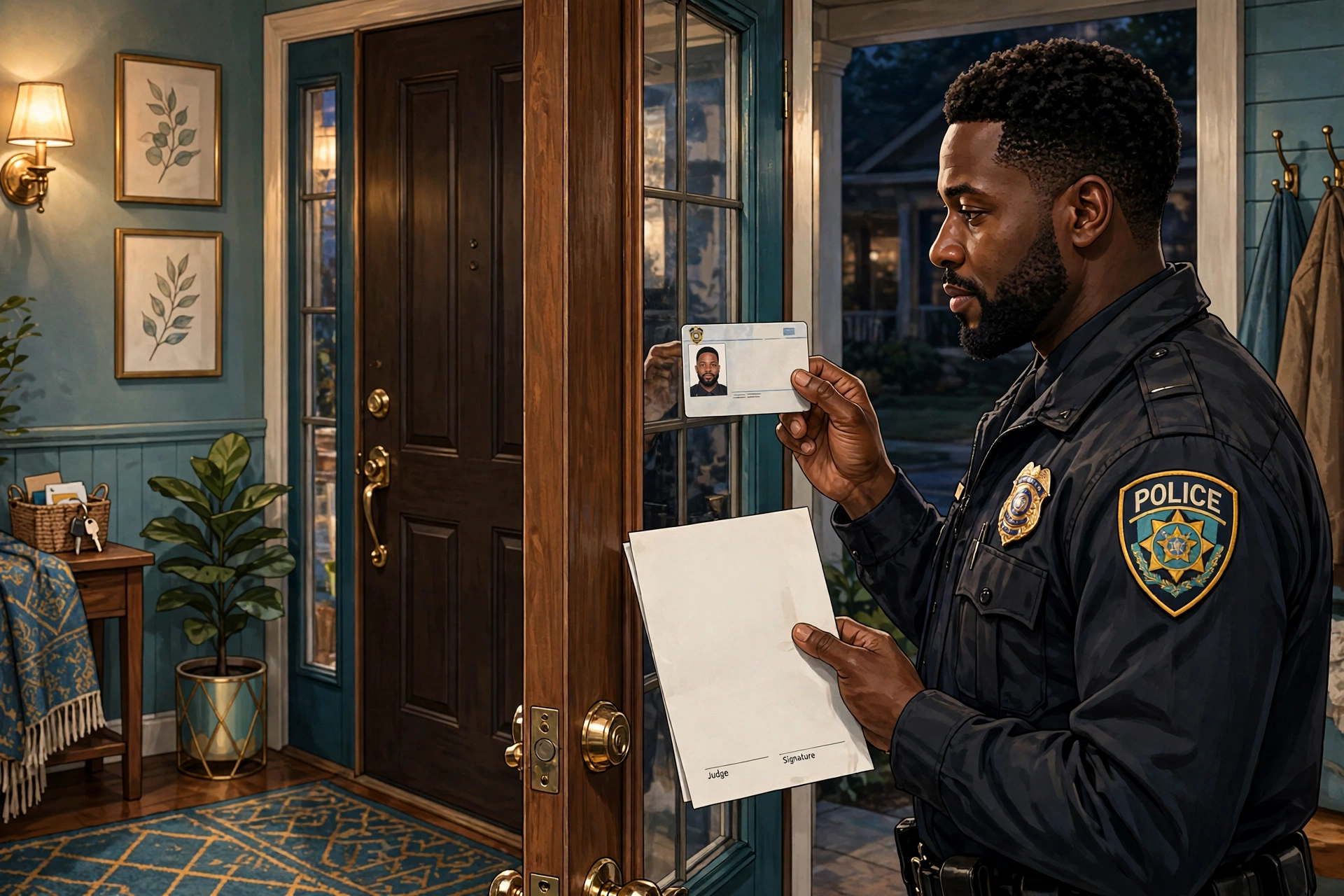
The knock comes early, before coffee, before the house is awake. A vest that says POLICE. A loud voice using your name. A demand to open the door right now.
Stop there. That pause is the whole game, because learning how to verify an ICE officer is real starts with one fact the pressure is designed to make you forget: you can check, through a closed door, before you hand over anything — your door, your papers, your money.
This is general information, not legal advice. For advice about your own case, talk to an immigration lawyer.
How to verify an ICE officer is real: start through the door
The ACLU's know-your-rights guidance is blunt about the first move: stay calm and keep the door closed. Speaking through the door is safer, and opening it does not by itself grant permission to enter — but a closed door keeps every option you have intact.
Ask two questions through it. Who are you with, and what are you here for? Then ask to see a badge and photo identification through a window or peephole.
That request is normal. California Attorney General Rob Bonta, warning about increased reports of fake ICE officers, puts it first on his list: ask for identification, because immigration authorities should carry identifying badges and credentials. Real officers carry both a badge and a photo credential. A vest alone proves nothing. Anybody can buy a vest.
Write down what you see: name, agency, badge number. If the person at the door won't show credentials, or the photo doesn't match the face, you have not met an officer you can trust. You've met a warning sign.
The warrant check separates paper from power
Next question: do you have a warrant signed by a judge?
If they say yes, the ACLU says to ask them to slide it under the door or hold it up to a window so you can read it yourself. Read the signature line. That line decides what the paper can do.
A judicial warrant — signed by a judge, naming a person in the home or the areas to be searched at your address — is the kind that can authorize entry. An ICE administrative warrant is different. A warrant of removal or deportation, Form I-205, is signed by an immigration official, not a judge, and the ACLU is clear that it does not allow officers to enter a home without consent.
So the check is simple. Judge's signature, your correct name and address: one kind of paper. An agency form signed inside ICE: another kind entirely. If there is no judicial warrant, keep the door closed and say it plainly: "I do not consent to your entry."
You also have the right to remain silent, even if an officer has a warrant, and you should not sign anything before you speak with a lawyer. Don't lie, and don't hand over false documents. Silence and a closed door are lawful. A lie is a new problem.
The ICE impersonator scam gives itself away at the ask
Some knocks aren't enforcement at all. They're theft wearing a badge.
The ICE impersonator scam runs on fear, and it breaks cover at the same point almost every time: the ask. Bonta's office warns that immigration officers will not ask for money or financial information, and will not typically call to warn you that you are about to be detained or arrested. The Department of Homeland Security says the same in its guidance for students: DHS will never ask you to transfer money to an individual, and it will never ask you to pay fees by phone or email.
So treat these as tells, not details:
- A demand for payment — cash, gift cards, a wire, crypto — to stop an arrest or fix a case.
- A threat that arrives by phone, text, or email saying you must act now or be detained.
- Pressure to stay on the line and keep the call secret from family.
- A refusal to show photo credentials, or anger when you ask.
- Papers you're told to sign fast, with blanks, or in a language you don't read.
One recent case shows how personal this can get. Federal prosecutors in Brooklyn announced that a former New York City police sergeant pleaded guilty to impersonating a United States officer under 18 U.S.C. § 912 after sending messages claiming to be the Director of ICE's New York Field Office and ordering a woman and her family to report to an ICE office or face enforcement action. He resigned on 25 September 2026 and faces up to three years in prison. The people doing it count on you being too scared to slow down and check.
The phone version is the same trick
Not every fake ICE officer knocks. Some call, and caller ID can lie: scammers spoof real government numbers so the screen shows an agency you recognize.
The move is identical. Hang up. Don't use a callback number the caller gave you. Look up the agency's number yourself on a .gov site — Bonta's office specifically warns that .com and .net lookalikes can mislead — and call that number if you need to check. A real office can be reached through its real number. A scammer can only be reached through his.
What to do with what you saw
If it was safe to do so, write down the time, names and badge numbers, what was said, and what vehicle was outside. The ACLU advises noting badge and patrol car numbers and filing a written complaint if you believe your rights were violated, and Bonta's office tells witnesses and victims of an immigration scam to report it to local law enforcement.
Then put the patrol on the pattern. The same habit that catches a fake prize pitch — slow down, check the source yourself, never pay to resolve a threat — is the one at work in how to spot a fake giveaway scam. If someone is working your block or your building with a fake badge and a script, report a tether with the details you wrote down. A case number turns a scary morning into a record somebody has to answer for.
The door is yours until a judge's signature says otherwise. Verify first. Open later, if at all.
Sources and further reading (checked 24 October 2026): ACLU — Immigrants' Rights / Know Your Rights (updated 4 August 2026) · California Attorney General — Warning Amid Increased Reports of Fake ICE Officers · U.S. Department of Justice, EDNY — Former NYPD Sergeant Pleads Guilty to Impersonating ICE Official · DHS Study in the States — Beware of DHS Imposters (19 February 2026)
Tags: how to verify an ICE officer is real · ICE impersonator scam · fake ICE officer · ICE warrant signed by a judge