
All-Black Towns in Oklahoma: More Than 50 Towns Black Americans Built and Governed
Listen to this article
Press play and take the patrol report with you.
Or listen in another language / choose a voice
Getting your device voices ready…
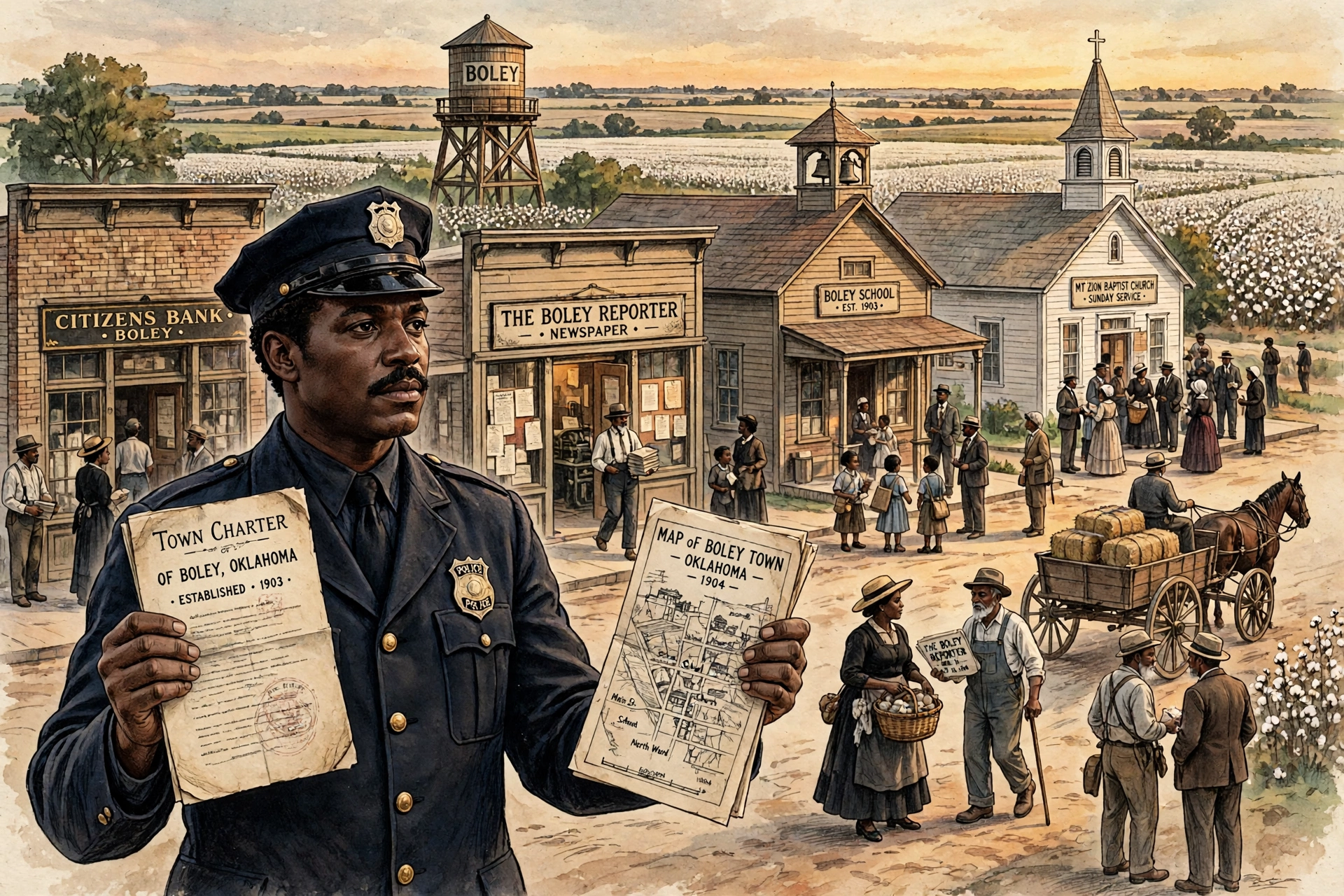
No other state did this at this scale. The all-Black towns in Oklahoma were not one town, not a neighbourhood, not a street. Between 1865 and 1920, Black Americans created more than fifty identifiable towns and settlements in Indian Territory and, after statehood in 1907, in Oklahoma itself. They platted streets, ran banks, printed newspapers, built schools and churches, and elected their own governments. Thirteen of those towns still survive.
What the all-Black towns in Oklahoma were
The Oklahoma Historical Society puts the point plainly: nowhere else, in the Deep South or the Far West, did so many Black men and women come together to create, occupy and govern their own communities. A town was the unit. Land first, then a market for nearby Black farmers, then the institutions that make a place hold — a school, a church, a newspaper that advertised the town across the South to the next family ready to move.
These were Black towns in America built by a people already rooted in this country. Dr. Claud Anderson named that people in Black Labor, White Wealth (1994) and PowerNomics (2001): native Black Americans, a non-immigrant lineage formed in the United States. The Oklahoma towns are that lineage with deeds and a town charter. The record of who they were sits in this site's framework post on Foundational Black Americans.
How the towns started: allotments, then the Land Run
The first towns grew in Indian Territory after the Civil War. Freedmen — people who had been enslaved by the Five Tribes — settled together for mutual protection and economic security. When the federal government forced individual land allotments, most of those freedmen chose land next to other Black Americans. Farming communities formed that could support businesses, and the communities became towns. Marshalltown, North Fork Colored, Canadian Colored and Arkansas Colored were already there in the 1860s. Tullahassee, in Wagoner County, is reportedly the oldest of the towns that survive.
The Land Run of 1889 opened more land, and Black settlers from the old South rushed in. E. P. McCabe, a former state auditor of Kansas, helped open Langston in April 1890 and started the Langston City Herald that October to recruit settlers across the South. McCabe wanted a Black political power bloc in the territory. Other leaders wanted an all-Black state. That state never came. The towns did, by the dozen.
Langston Oklahoma history carries a second anchor: in 1897 the territorial legislature established the Colored Agricultural and Normal University there — the school that became Langston University. A college gave a small town a payroll, a reason to stay, and a shield in hard years. Langston counted 251 people in 1890 and 1,619 in the 2020 census.
Boley: the town that proved the point
Boley Oklahoma history is the headline case. Boley was established in 1903 on land allotted to Abigail Barnett, the daughter of a Creek freedman, and incorporated on 11 May 1905. Its weekly paper, the Boley Progress, started the same year and carried the town's name through the South.
By 1911 Boley held more than 4,000 citizens, two banks and three cotton gins. It had its own electrical generating plant, water system and ice plant, and two colleges. Booker T. Washington visited twice, and his 1908 Outlook article called Boley the most enterprising and, in many ways, the most interesting Negro town in the United States. Read that sentence for what it is: a town four years from incorporation, measured against the whole country, by the hardest grader Black America had.
Why most of the towns fell
Statehood brought Jim Crow laws from the new Oklahoma Legislature, and some settlers left — for Canada's plains, for Mexico, for other ground. White hostility worked at the local level too. In 1911, white farmers in Okfuskee County signed oaths pledging never to rent, lease or sell land to a person of Negro blood within a mile of a white or Indian resident, and a matching oath tried to cut off Black hired labour.
The kill shot was economic. These were small farming towns; prosperity rode on cotton. The Great Depression crushed crop prices, railroads failed and cut towns off from markets, and white lenders would not extend credit to Black farmers and businessmen. People left for jobs north and west, the tax base thinned, and town after town went under. Even Boley declared bankruptcy in 1939. The same pattern ran through the freedom colonies of Texas, where the Texas State Historical Association counts more than 550 Black settlements — most now gone from the maps, kept in cemeteries, churches and descendants' memory. Land records are how families trace that ground back; this patrol's guide to searching Freedmen's Bureau records shows where that paper lives.
The thirteen that still stand
Thirteen historic towns survive: Boley, Brooksville, Clearview, Grayson, Langston, Lima, Red Bird, Rentiesville, Summit, Taft, Tatums, Tullahassee and Vernon. A fourteenth, IXL, incorporated in 2001. Boley still hosts the nation's oldest Black community rodeo every Memorial Day weekend, and its downtown business district is a National Historic Landmark.
Survival is not nostalgia. A surviving town is a government that never handed its charter back — land held, in a lineage name, across the Depression, the credit freeze and the highway era. That is the record the patrol files: a people formed on this soil built towns on this soil, and thirteen of them are still on the map. The officer's beat is set out on the About page. Patrolling the online borders, one tether at a time.
Sources and further reading (checked 10 November 2026): Oklahoma Historical Society — All-Black Towns, Encyclopedia of Oklahoma History and Culture · Oklahoma Historical Society — Boley · Oklahoma Historical Society — Langston · National Museum of African American History and Culture — All-Black Towns · Texas State Historical Association — Freedmen's Settlements, Handbook of Texas Online
Tags: all-Black towns in Oklahoma · Boley Oklahoma history · Black towns in America · Langston Oklahoma history