
Black Barbershop Culture: More Than a Haircut, a Community Institution
Listen to this article
Press play and take the patrol report with you.
Or listen in another language / choose a voice
Getting your device voices ready…
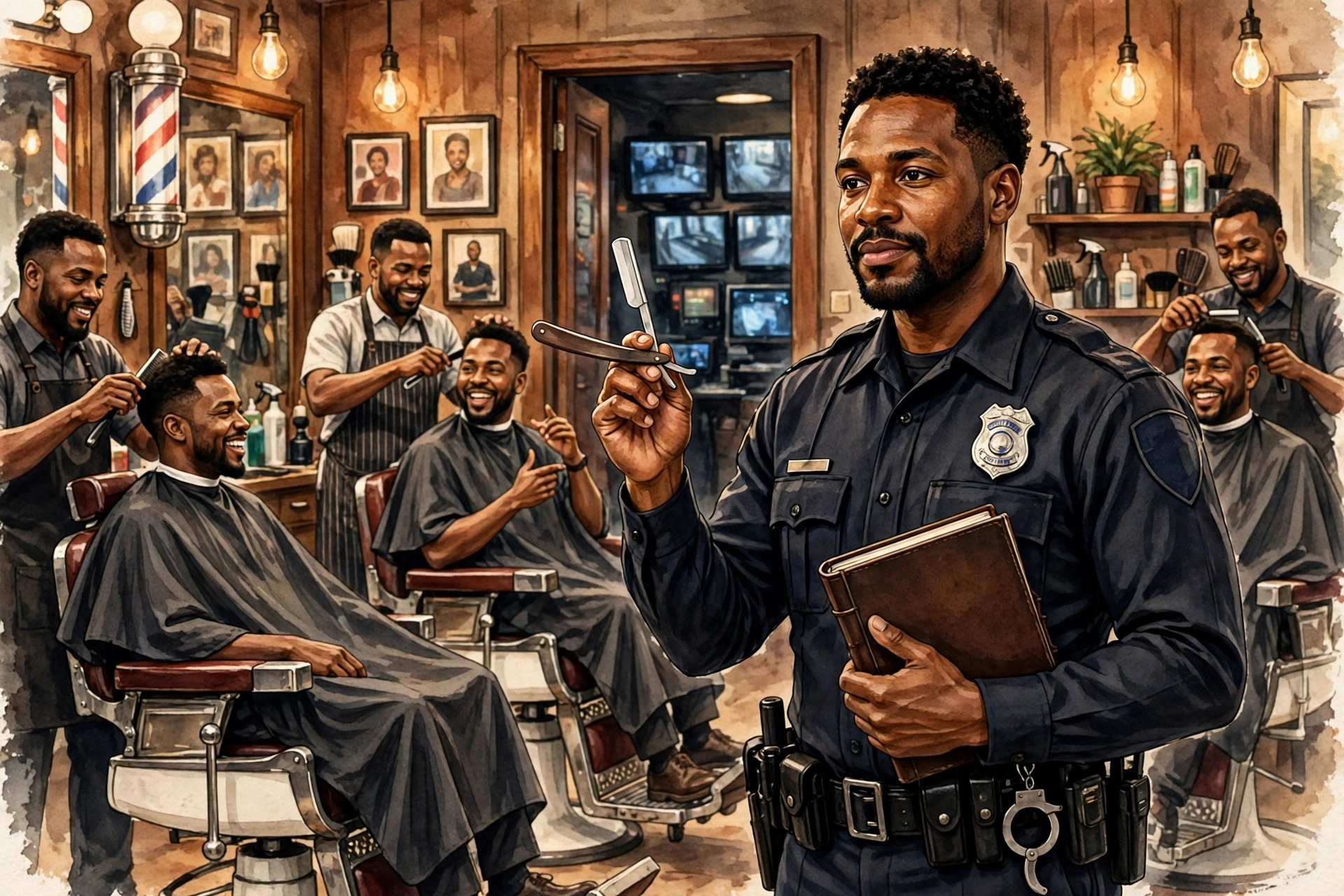
You can get a haircut in a lot of places. You can only get Black barbershop culture in one. Walk in and the room announces itself: chairs in a row, waiting seats full, the game on, the debate already running before your name is called. A cut takes twenty minutes; the visit takes as long as it takes. The shop is a business, a newsroom, a debating hall, and a room where a boy watches men handle money, talk plainly, and keep each other's confidences.
What is Black barbershop culture?
Call Black barbershop culture the working habits of a Black American institution: a Black-owned shop serving its own neighborhood, a barber who knows your family and your last three haircuts, and talk that moves from sports to city hall to somebody's son needing a job. Historian Quincy T. Mills spent the summer of 2000 sitting in a South Side Chicago shop, watching that talk, while helping Melissa Harris-Perry research Barbershops, Bibles, and BET. Mills stayed with the question for a decade; his Cutting Along the Color Line (2013) is the record this post leans on.
Black barbershop history starts with a trade held under constraint
The Black barbershop history does not start with a shop serving Black customers. It starts almost backwards. In the 18th and early 19th centuries, barbering in the South was work done by Black men — enslaved men leased out for their grooming skill, and free Black men in the same trade. Before the Civil War, most established Black barbers groomed wealthy white men, and Black customers were not allowed in those chairs: white patrons would not sit for a shave next to a Black customer. Barbering was looked down on as unskilled service work — and the men who did it best were Black.
So where did Black men get a cut? On a porch. In a yard. Off the books, after hours. After the Civil War, the refusal itself became the fight: Black communities protested barbers who still would not serve Black men, and the Civil Rights Act of 1875 guaranteed Black Americans access to public accommodations. The Black barbershop tradition readers know — the shop as our room — came out of that turn: the same trade, finally pointed at its own people.
The barbers who turned chairs into companies
Some barbers built empires on a trade that paid cash in an economy that blocked Black men from most ownership. Alonzo Herndon, born into slavery in Georgia in 1858, owned Atlanta barbershops serving affluent customers and used that base to found the Atlanta Life Insurance Company in 1905 — becoming one of the first Black millionaires in the United States. John Merrick in Durham, North Carolina, ran multiple shops and put barbershop money behind the North Carolina Mutual Life Insurance Company. The point behind both stories: white insurers would not insure Black lives, so barbers — men who already held their community's trust and its cash flow — built the companies that would.
Licensing tried to close the door, so Black barbers built schools
The counter-move came dressed as professionalism. In the 1890s, a barbers' union led largely by German immigrant barbers pushed state licensing laws requiring a barber college degree — and the colleges did not admit Black men. Mills is blunt about the motive: market share, not hygiene. The answer came in 1934, when Henry Miller Morgan founded Tyler Barber College in Tyler, Texas — the first national chain of barber colleges for Black Americans. At its height, nearly 80 percent of Black barbers in the country had trained at Tyler or its affiliated schools, per the National Association of Barbers. Shut out of the classroom, the trade built its own.
Under segregation, the shop's second job hardened into place: one of the few indoor rooms where Black men could gather freely, read the Black press, argue politics, and plan. That is the same job this patrol traced in the Black family reunion tradition, an institution built to keep a people's record in person, and it rhymes with HBCU homecoming culture: a built return, on purpose, to a room that is yours.
The trust, measured
Medicine tested that trust. In a trial published in the New England Journal of Medicine in 2018, researchers enrolled 319 Black men with uncontrolled high blood pressure from 52 Black-owned barbershops in Los Angeles County. In half the shops, barbers steered patrons to specialty pharmacists who met them in the shop and managed their medication with their doctors; in the other half, barbers encouraged lifestyle changes and doctor visits. Six months in, systolic pressure had fallen 27.0 points in the pharmacist group against 9.3 in the control group, and 63.6 percent reached a reading under 130/80, against 11.7 percent of controls. Clinics had missed these men for years. The shop did not miss them, because the Black barbershop community runs on a barber's word, kept weekly, for decades.
What the patrol watches now
The shop has moved online — booking apps, deposit links, shop pages on social media. The cracks are familiar ones: a copied shop page collecting deposits for chairs that do not exist, a fake booking link harvesting card numbers under a real barber's name. Book through the number or page the shop itself posted, and pay deposits only to the name the barber gives you in the chair. If a page is taking money in a real shop's name, save the link and screenshots and report a tether.
A haircut grows out in three weeks. The institution has held for over a century, because the room does work no app has replaced: news checked by people who know you, counsel from a man holding a razor and your confidence at the same time, and a first chair a father lifts his son into like an introduction. The officer's beat is set out on the About page. Patrolling the online borders, one tether at a time.
Sources and further reading (checked 9 November 2026): National Association of Barbers — The History of Black Barbershops · Collectors Weekly — Straight Razors and Social Justice (interview with Quincy T. Mills) · Victor et al. — A Cluster-Randomized Trial of Blood-Pressure Reduction in Black Barbershops, New England Journal of Medicine, 2018 · Vassar College — A Cutting Narrative, on Cutting Along the Color Line (2013)
Tags: Black barbershop culture · Black barbershop history · Black barbershop tradition · Black barbershop community