
Black Family Reunion Tradition: More Than a Cookout, a Record Kept in Person
Listen to this article
Press play and take the patrol report with you.
Or listen in another language / choose a voice
Getting your device voices ready…
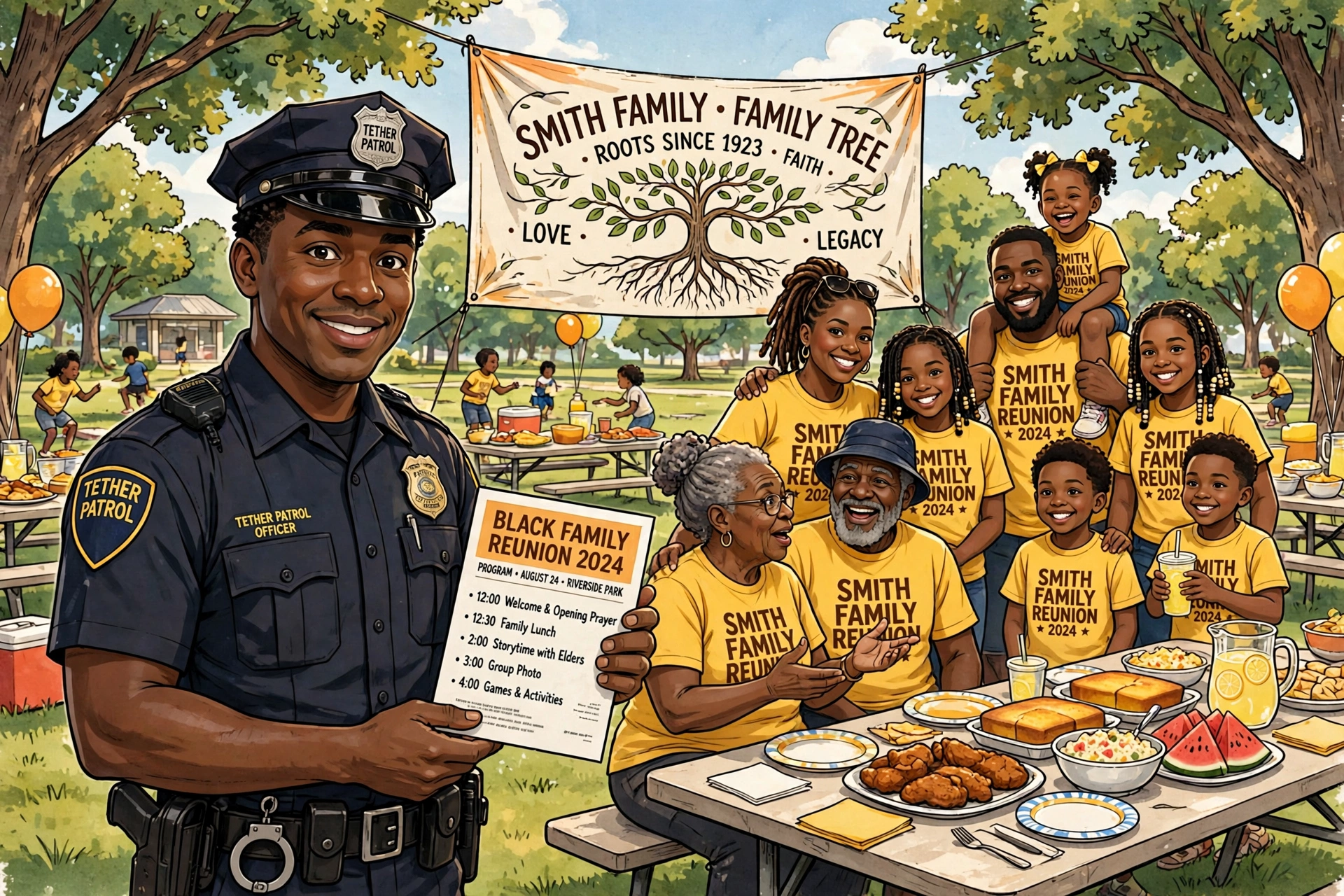
The matching shirt gets the photograph. It does not explain the weekend. The Black family reunion tradition is a working piece of Black American culture: elders telling the names out loud, a printed program nobody throws away, a table for the relatives who did not live to sit at it. Under the cookout smoke sits an older job. This tradition was built to put a family back together — and then to keep it together, year after year.
What is the Black family reunion tradition?
Call it a Black American family reunion in its plain form: a planned return, usually in warm weather, where branches of one family travel to one place, eat together, worship together in many cases, and hand the young people a map of who they belong to. The Smithsonian's National Museum of African American History and Culture names the hallmarks plainly — a program, a group photo, and a T-shirt that put a tangible stamp on the ties.
Those objects are not souvenirs. A program is a roster. A group photo is proof, dated and faced. A shirt worn home is the family name walking through an airport in another state.
Black family reunion history starts with a search
The Black family reunion history does not start with a picnic. It starts with people freed in the United States looking for kin sold away from them under slavery.
After emancipation, and with the ratification of the Thirteenth Amendment, searching became one of the first exercises of freedom. The museum's account is direct: newspaper advertisements, letters, and word of mouth carried the search. Parents looked for children. Spouses looked for each other.
The scale survives in the archive. The Last Seen project, built from those "Information Wanted" and "Lost Friends" notices in Black newspapers and church periodicals, has gathered more than 4,500 advertisements, with pastors reading notices aloud from pulpits for people who could not read them in print. Families also made their unions legal where they could, chose names for themselves, and fought for authority over their own children — the record this patrol traced in its Freedmen's Bank history post, from the same years when freedmen built savings on paper that had never carried their names before.
Not every search ended in an embrace. The tradition holds both facts at once: some lines were found again, and some breaks never closed.
The Great Migration turned the search into a homecoming
A second scattering tested the habit. Between 1910 and 1970, roughly six million Black Americans left the rural South for cities in the North, Midwest, and West. A family that had lived within walking distance now needed trains, then highways, then plane tickets to sit in one yard.
Reunions answered that distance. The University of Alabama at Birmingham's Institute for Human Rights describes how reunions became anchors during the Great Migration — relatives returning to a home place, children born in northern cities learning the Southern ground their people came from. Stories did the carrying where paper was thin: who held the family land, who raised children who were not their own, how a name passed down. Recipes, hand games, and hair braiding taught at the gathering belong in that same archive.
That is why a reunion weekend resembles HBCU homecoming culture at family scale. Both are built returns. Both put alumni — of a school, or of a household — back in front of the young, in person.
In 1986, the family reunion went national
Dorothy Height and the National Council of Negro Women scaled the form up. The National Black Family Reunion 1986 opened on the National Mall in Washington, D.C., over two days in September, after Height and the council rejected a television portrait that reduced Black family life to a crisis story. Their answer was not a press release. It was a demonstration: roughly 200,000 people, health screenings, job information, food, gospel music, and families standing where cameras had to record strength.
The celebration spread to Atlanta, Philadelphia, and Los Angeles, then to Chicago, Cincinnati, and Memphis. By September 1992, more than ten million people had attended, per the African American Intellectual History Society's account.
Scholarship kept pace. Dr. Ione Vargus began studying Black reunions in the 1980s, collected accounts at gatherings from Boston to the Carolinas, and founded the Family Reunion Institute at Temple University in 1990 to help families plan and keep their reunions. Her nickname tells the standing of that work: "Mother of Family Reunions."
What the patrol watches during reunion season
Tether Patrol's beat is screens, and reunion season now lives there too — group chats, shared photo drives, online fundraisers, hotel blocks booked through links passed hand to hand. Most of it is family business in new tools, and the UAB account notes technology helping relatives gather when money, work, and health get in the way.
The cracks show where money moves on trust. A fake hotel-block page wearing the family name, a payment link that is not the organizer's, a copied page collecting "shirt money" — those are tether moves dressed in family colors. Check the organizer by voice, not by profile photo. Pay through the channel the family named at the last gathering or in its program. If a page is harvesting payments in a family's name, save the link and screenshots and report a tether.
A tradition that survived forced separation and a six-million-person migration can survive a fake payment page, if somebody checks the paper first.
The officer's own people built this form in this country, out of a search conducted in American newspapers, churches, and hometowns. A Black family reunion is a record kept in person — told by elders, worn on a shirt, and renewed every time the branches travel back to one table. The officer's beat is on the About page. Patrolling the online borders, one tether at a time.
Sources and further reading (checked 4 November 2026): National Museum of African American History and Culture — The Historical Legacy of Black Family Reunions · UAB Institute for Human Rights — More than a Cookout: Black Family Reunions as Acts of Resilience · AAIHS — Dorothy Height, NCNW, and the National Black Family Reunion · Temple University — Remembering Ione Vargus
Tags: Black family reunion tradition · Black family reunion history · Black American family reunion · National Black Family Reunion 1986