
Freedmen's Bank History: The Savings Freedmen Built and the Collapse That Took Them
Listen to this article
Press play and take the patrol report with you.
Or listen in another language / choose a voice
Getting your device voices ready…
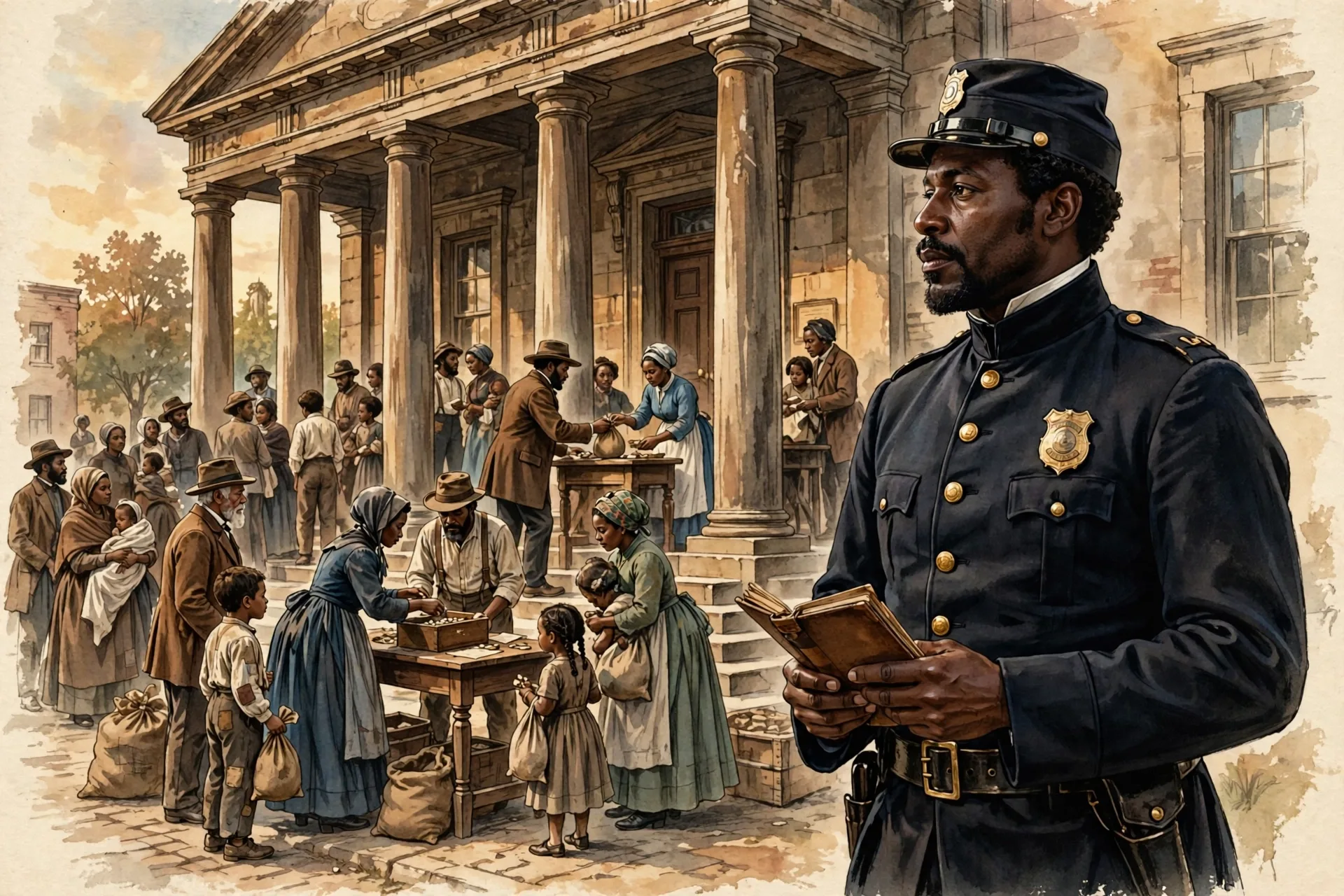
Freedmen's Bank history starts with a line in a charter. On 3 March 1865, Congress created a savings bank for one specific people: persons heretofore held in slavery in the United States, or their descendants. Not a general bank that happened to take Black customers. A bank written, on paper, for freedmen and the children of freedmen — the same lineage this patrol calls Foundational Black Americans.
These were people already here, already American, emerging from slavery in the United States into freedom in the United States. They had wages from Union garrisons, pay from Black regiments, and small sums scraped together in households allowed to keep almost nothing. They needed a place to put it that would still be there in the morning.
What was the Freedmen's Bank?
The plain answer to what was the Freedmen's Bank is this: the Freedmen's Savings and Trust Company, chartered by Congress on 3 March 1865 and signed into law by President Lincoln that same day. John W. Alvord and A. M. Sperry had pushed for a single institution to replace the scattered military savings banks of the Civil War, where lost records had already cost Black soldiers their deposits.
Headquarters started in New York, then moved to Washington, D.C. in 1868. At its peak the bank ran 37 branches in seventeen states and the District of Columbia, one of the first multi-state banks in the country. By 1870 nearly all the local branches were run by Black staff. Most accounts held between $5 and $50. Some were opened with pennies.
The charter said deposits could only be received by or on behalf of the freed people named above and their descendants. Unclaimed accounts were to go into a fund to educate the children of ex-slaves. Interest up to 7% was allowed.
Freedmen's Bank history is a lineage record
Dr. Claud Anderson made the wider argument decades later in Black Labor, White Wealth (1994) and PowerNomics (2001): the descendants of American slavery are native Black Americans, a non-immigrant people whose labor built this country and whose claims do not blur into a general category. The bank's charter had already drawn that same line in 1865, in banking language. Eligibility ran by descent.
That is why the records still pull genealogists in. The bank's surviving papers hold an estimated 480,000 names, described as the largest single repository of lineage-linked Black American records, now indexed and searchable. A passbook listed family, place, and work — a paper trail a people created in their own names.
Tens of thousands of freedmen and their families deposited on purpose. Saving was the plan. The failure was not in the depositors.
The Freedman's Savings Bank collapse
The Freedman's Savings Bank collapse did not come from small accounts. It came from the top.
All fifty original trustees were white, and the charter carried no real penalty to hold them personally liable for the bank's solvency. The bank was marketed in churches, Freedmen's Bureau schools, and Black newspapers, often with the impression that the federal government guaranteed every dollar. It did not. It was a private corporation.
Congress then loosened the rules. An 1870 amendment let the bank lend against real estate with up to half its funds. Managers put money into speculative railroad bonds and risky loans, built an expensive Washington headquarters, and tied cash closely to Jay Cooke and Company. When the Panic of 1873 hit, the weakness showed at once.
In March 1874 the trustees turned to Frederick Douglass, electing him president to restore confidence. Douglass put in tens of thousands of dollars of his own money. Within weeks he saw the bank was insolvent and advised Congress to shut it down. In a private letter he put it bluntly: it had been the Black man's cow, but the white man's milk.
The bank closed on 29 June 1874. At closing, $2,993,790.68 was due to 61,144 depositors, per the record kept by BlackPast from the commissioners' figures. The Smithsonian's National Museum of African American History and Culture puts it in round terms that land just as hard: over 60,000 depositors lost nearly $3 million, and after years of petitioning, little more than half — $1.7 million — was ever repaid. The Kansas City Fed's history notes the largest recovery was 62 cents on the dollar, received by less than a third of account holders, and only after several years. One Smithsonian dividend check paid a depositor twenty cents in 1880 — ten percent of a $2 deposit, six years after the doors closed.
Depositors had believed the government stood behind the bank because the bank let them believe it. Many could not prove a relationship to a depositor who had died, or sold their claims cheap just to eat. Historians trace a distrust of banking in Black communities for generations to this failure. That distrust was not ignorance. It was experience, documented.
Why the patrol keeps this file open
Tether Patrol works screens, not vaults. The lesson travels anyway.
A trusted name, an official-looking charter, a famous face brought in at the end to calm people down — none of that replaces checking who controls the money and what guarantee actually exists in writing. Freedmen in 1865 did the responsible thing and were failed by the men running the institution. Their descendants learned to ask harder questions, and then built their own: the first Black-owned banks followed in the late 1880s, raised from churches, fraternal orders, and mutual aid societies.
Read the lineage post for the framework behind the name — Foundational Black Americans — and the officer's own story on the About page. If you face a modern version online — a fake bank page or an account harvesting deposits in a trusted name — report a tether with the link and screenshots. The names on those old passbooks deserved a bank that kept its word. The names on today's timelines deserve the same.
Sources and further reading (checked 26 October 2026): Smithsonian / NMAAHC — Dividend check from Freedman's Savings and Trust Company · BlackPast — Freedmen's Savings and Trust Company (1865-1874) · Wikipedia — Freedman's Savings Bank · Federal Reserve Bank of Kansas City — Let Us Put Our Money Together: The Founding of America's First Black Banks
Tags: Freedmen's Bank history · Freedman's Savings Bank collapse · what was the Freedmen's Bank · Freedmen's Savings and Trust Company