
Nicodemus Kansas History: The Black Town That Still Stands on the Plains
Listen to this article
Press play and take the patrol report with you.
Or listen in another language / choose a voice
Getting your device voices ready…
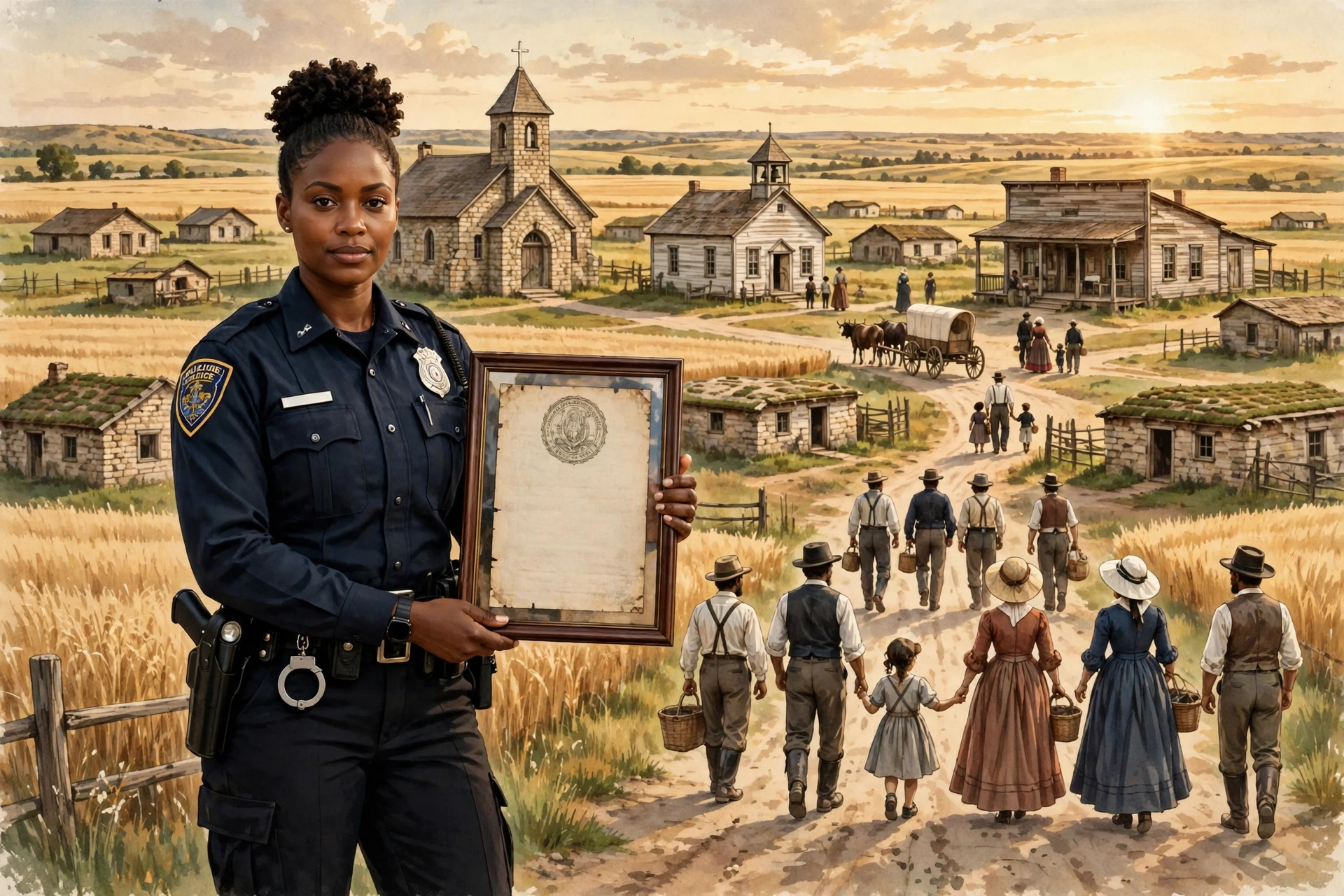
Drive Highway 24 through Graham County and the town almost hides. A few stone buildings. Wheat to the horizon. Nicodemus Kansas history starts there, in 1877, when Black settlers from Kentucky crossed the plains to build a town of their own on the Solomon River — and kept it alive long after bigger places gave up.
What is Nicodemus Kansas history about?
Call Nicodemus Kansas history the record of a Nicodemus Kansas Black town founded on purpose. The National Park Service calls Nicodemus the first Black community west of the Mississippi River and the only predominantly Black community west of the Mississippi that remains a living community today. Congress made it a National Historic Site in November 1996. Landmark status came earlier, in 1976.
The timing mattered. Reconstruction was collapsing in the South in 1877, and gains Black Americans had made after emancipation were being rolled back county by county. Kansas carried a different reputation: a free state since 1861, tied in Black memory to John Brown and the Underground Railroad. For families in Lexington and Georgetown, Kentucky, Kansas read as ground where a Black man could own land, vote, and put his name on a deed without asking permission.
That is the native ground Dr. Claud Anderson names in his "native Black American" framing — a people formed in the United States, building institutions here, on land they worked themselves. Nicodemus is that argument in stone and sod.
A town company, a handbill, and a walk in
On 18 April 1877, seven Kansans — six of them Black — formed the Nicodemus Town Company. W. H. Smith, a Black minister, served as president; W. R. Hill, a white land speculator, served as treasurer. Their goal was plain: the first all-Black settlement on the Great Plains.
The company printed circulars inviting Black families to the Great Solomon Valley. The Reverend Simon P. Roundtree arrived first, on 18 June 1877. In September, a large group from the Lexington area reached the townsite after rail tickets brought them only as far as Ellis, still miles away. Some of the roughly 300-plus early settlers took one look at the remote, treeless ground and turned back. The ones who stayed dug in — literally. First homes were dugouts cut into the river bluffs. Sod houses followed. Frame houses came later, when money allowed.
Williana Hickman, arriving in spring 1878, remembered asking where Nicodemus was. Her husband pointed at smoke rising from the ground — from dugout chimneys — and said that was it. She cried at the sight. Then she stayed, like the rest of the town's founders did, and helped build the place she could not yet see.
The town they built on the prairie
Growth came fast. By the mid-1880s Nicodemus held stone buildings, churches, hotels, a schoolroom, a newspaper, a bank and a society hall, with about 150 permanent residents in town and more on farms around it. At its height the wider community counted a post office, an ice cream parlor, a baseball team and two newspapers. Jenny Smith Fletcher helped found the African Methodist Episcopal congregation, the town's first church.
Politics followed the building. Nicodemus voters helped elect Black officials at county and state level, and Edward P. McCabe, who lived in Nicodemus, became a statewide officeholder in Kansas. A town run by Black Americans, taxing itself, schooling its children, printing its own paper — that was the point of the move west, not scenery.
Nicodemus also sits inside wider Exodusters Kansas history. Benjamin "Pap" Singleton, a Black carpenter from Nashville who promoted Kansas colonies across the South, spread the same circulars. Between 1877 and 1879 more than 20,000 Black Americans left the South for Kansas; the state's Black population rose from 17,108 in 1870 to 43,107 in 1880. Most of those settlements faded. Nicodemus held.
The railroad that never came
The break came in 1887 and 1888. Residents had backed a bond to pay the Missouri Pacific Railroad to lay tracks through town. The railroad bypassed Nicodemus instead — the Union Pacific line passed about six miles away, through Bogue. Trade moved to the depot towns. Drought and grasshopper years hit the farms. Families drifted to Bogue or farther west for wage work.
Nicodemus shrank, but it did not close. Farm families stayed in the township. Churches kept meeting. The Emancipation and Homecoming celebration, held since 1878 on the last weekend of July, kept pulling descendants back to Graham County every summer — a return this patrol has traced in other rooms Black Americans built, from the oldest Black town west of the Mississippi to the all-Black towns in Oklahoma that rose a generation later.
Five buildings hold the record now
The National Park Service preserves five historic structures: the First Baptist Church, the African Methodist Episcopal Church, the St. Francis Hotel, the District No. 1 Schoolhouse, and Nicodemus Township Hall, which serves as the visitor center. Together they map the whole town in miniature — worship, lodging and business, schooling, and self-government.
A handful of residents live there now, some descendants of the 1877 settlers. Every other Black town founded west of the Mississippi in that era is gone as a living community. This one still has an address, a township, a homecoming, and families who can name the dugout their people started in.
The patrol's beat is screens, not sod houses. Still, the lesson travels: a record kept by the people it belongs to survives. Deeds, church rolls, school lists, a newspaper — Nicodemus kept its paper, which is why its story can be checked instead of guessed at. Keep your own family's records the same way, and bring a copied name or a faked claim about this lineage to report a tether when you spot one working the timeline. The officer's beat is set out on the About page. Patrolling the online borders, one tether at a time.
Sources and further reading (checked 15 November 2026): National Park Service — Kansas: Nicodemus National Historic Site · National Park Service — Nicodemus National Historic Site · Kansas Sampler Foundation — 8 Wonders of Kansas History: Nicodemus · National Geographic — Before the Great Migration, there was the Great Exodus
Tags: Nicodemus Kansas history · Nicodemus Kansas Black town · Exodusters Kansas history · oldest Black town west of the Mississippi