
He Swore on His Life. The Case File Says Nobody Knows.
Listen to this article
Press play and take the patrol report with you.
Or listen in another language / choose a voice
Getting your device voices ready…
Analysis — Tether Patrol
Javits Frimpong was 15 years old. He came from Ghana a year before his death to live with his father in the Bronx, for a better life. On the morning of October 29, 2026, walking to school, he was shot in the stomach in Van Cortlandt Park, chased as he ran wounded, and he died at the hospital. His father had woken him up that morning. There was no goodbye.
That is the case. Here is the rest of the case, the whole of it: police are looking for three teenage boys seen fleeing in a black hoodie, sweatpants and a mask. There have been no arrests. No motive has been established. No suspect's race, ethnicity or nationality has been identified by police — not Black American, not African, not anything. Javits's father believes his son had been having trouble with kids at school that week; two students were suspended days earlier. Police have expressly not confirmed a bullying motive. That is where the file ends, because that is where the evidence ends.
Now meet the video.
What the video says
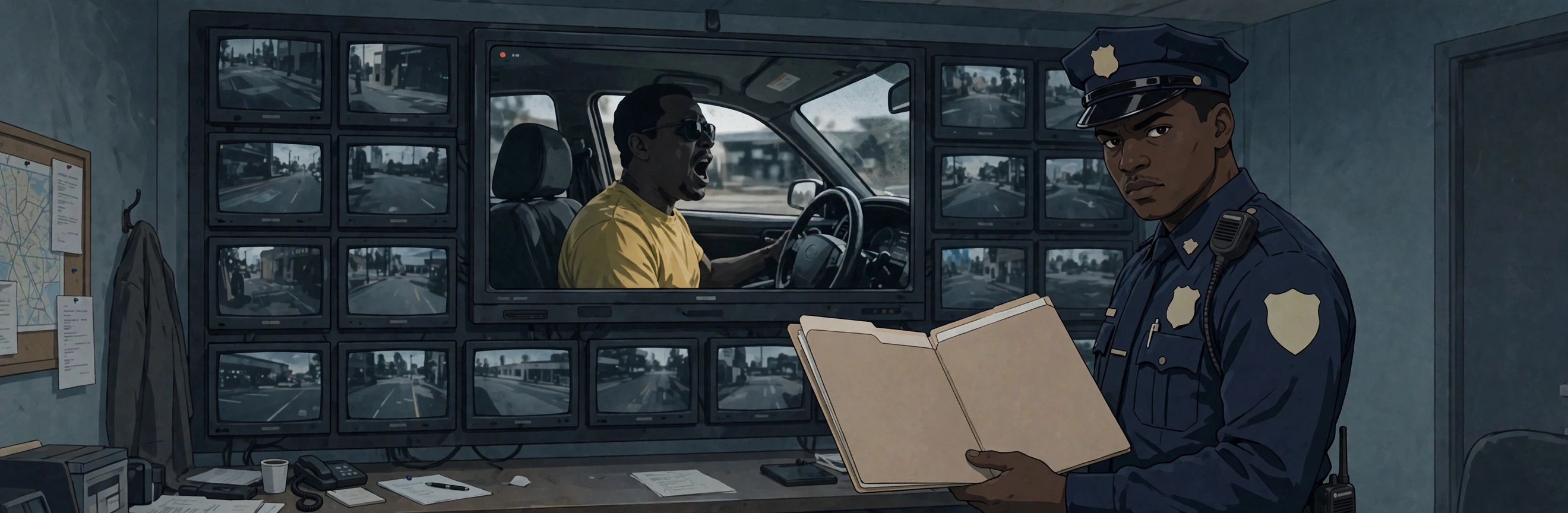
A man in a car — yellow shirt, sunglasses, no name anywhere on the post — took that open file and closed it himself, on camera, within days of the killing. His words:
"The people who did that act are not Africans. The people who did that act are not white people. The people who did that act are not Chinese. The people who commit that crime are definitely Black American kids."
"I will swear with my life" on it, he says. "Stay away from Black American kids. Stay away from Black Americans. This is the perfect example… Our parents were right."
He tells you the dismissal in advance: don't come with "not all Black Americans" — if a majority share the mentality, the warning stands. Bullying, he says, "is only coming from Black Americans, it's not coming from other cultures." A second man, cut in below him, adds the refinement: there is "a big difference between the ghetto so-called Black American and the so-called Black American" — and this dead child is "why" African fathers and uncles warn their children away.
Notice the evidence offered for an ethnic verdict in an unsolved homicide: a television interview with the grieving father, in which the father identifies nobody. The father's grief is real. It is also not evidence of who shot his son, and the men in this video used it as their exhibit anyway.
The legal breakdown
An indictment with no defendant. American defamation law protects identifiable people. A claim this broad — an entire ethnic nation of more than forty million pronounced guilty of a specific child's murder — has no plaintiff the courts can recognise, which makes it legally costless to say. That is not a defence of the video; it is an indictment of the gap. The law can punish a lie about a person. A lie about a people, attached to a real corpse, it mostly cannot touch. Men like this have learned exactly where that gap is, and they broadcast from inside it.
Contaminating an open investigation. Police have one useful thing to work with: what witnesses actually saw — a hoodie, a mask, a direction of flight. A viral video announcing the perpetrators' ethnicity as sworn fact does the opposite of help. It overwrites witness memory, floods tip lines with a narrative instead of descriptions, and hands the real killers the best cover they could ask for: a city arguing about a phantom while three teenagers in masks walk unidentified. If you wanted the people who shot Javits Frimpong caught, this video is not a strange way to show it. It is the opposite way.
The bullying frame, smuggled. The father's belief that his son was defending himself against school trouble is a father's belief — reported as such, unverified by police. The video upgrades it silently into the motive, then hangs the motive on an ethnic group. Two unproven steps, presented as one sworn certainty.
The psychological breakdown
The case was never examined. It was used. Within days of a child's death, before an arrest, before a name, the killing was converted into a proof: proof that a warning issued in African households — stay away from Black Americans — was right all along. That warning is a documented piece of immigrant socialisation; sociologists have written about it for decades. What this video does is perform it in public, over a body, and call the performance evidence. Confirmation bias usually needs time to bend a story. Here it did not even wait for the funeral.
An unfalsifiable machine. Watch the mechanism: "not all" is pre-dismissed, the majority-mentality clause means any crime committed by any Black American anywhere, forever, becomes another exhibit, and no exculpatory fact can ever register — because the theory was never built from facts in the first place. A belief system that every event confirms and no event can dent is not an observation about Black Americans. It is a story its tellers need, and Javits Frimpong's death was simply the newest occasion to tell it.
Status, envy and the borrowed ground. Here is the part the video will not say about itself. Black Americans are a people formed in America — a Freedmen lineage, in the line of Dr. Claud Anderson's teaching, with four centuries of building this country under its boot. The newcomer who arrives into the safety, infrastructure and civil-rights ground that people fought and died to clear, and then announces from a car that those people's children are a category of threat to be avoided — that is not self-protection. It is a status claim dressed as a safety warning: we are the good ones; they are the danger. A dead Ghanaian boy becomes the credential for it. His father, who sent for him so he could have a better life among the very people now indicted wholesale, is conscripted as the star witness for a claim he never made.
Why delineation follows. Black Americans did not invent the distance this video complains about; videos like this one manufacture it. Tell a people, on camera, sworn on a stranger's life, that your children must be protected from their children — on the evidence of a case with no suspects — and the withdrawal that follows is not paranoia. It is pattern recognition. Every cycle of this content pushes delineation further, and the next video will call the delineation itself proof of hostility. The loop is the product.
What justice for Javits actually requires
It requires the three teenagers in the masks to be identified — by evidence, by witnesses describing what they saw, by police work unpolluted by viral verdicts. It requires the bullying question to be investigated rather than assumed. And it requires that a father's worst morning not be strip-mined, within seventy-two hours, into content for a feud he never declared.
On this patrol, a claim about a crime is a claim about a case file. If it is not in the file, it does not run. The file, today, says: a 15-year-old boy is dead, three suspects are unidentified, and nobody — not a man in a car, not anyone — knows who they are.
He swore on his life. The file says he was swearing on nothing.
Sources and further reading (checked 5 November 2026): NYPD suspect reporting via ABC7 New York, Gothamist and CBS New York (no arrests, no motive established, no suspect identity released) · MEAWW — police have not established a motive; the bullying link is the father's belief · Baller Alert — NYPD subpoenas the Department of Education; three possible motives examined, none established · Wikipedia — Killing of Javits Frimpong · The reel itself, viewed in full (speaker quotations from burned-in captions and audio)
Tags: who killed Javits Frimpong · Javits Frimpong suspects · stay away from Black Americans video · Black American delineation · African immigrants and Black Americans